.svg)

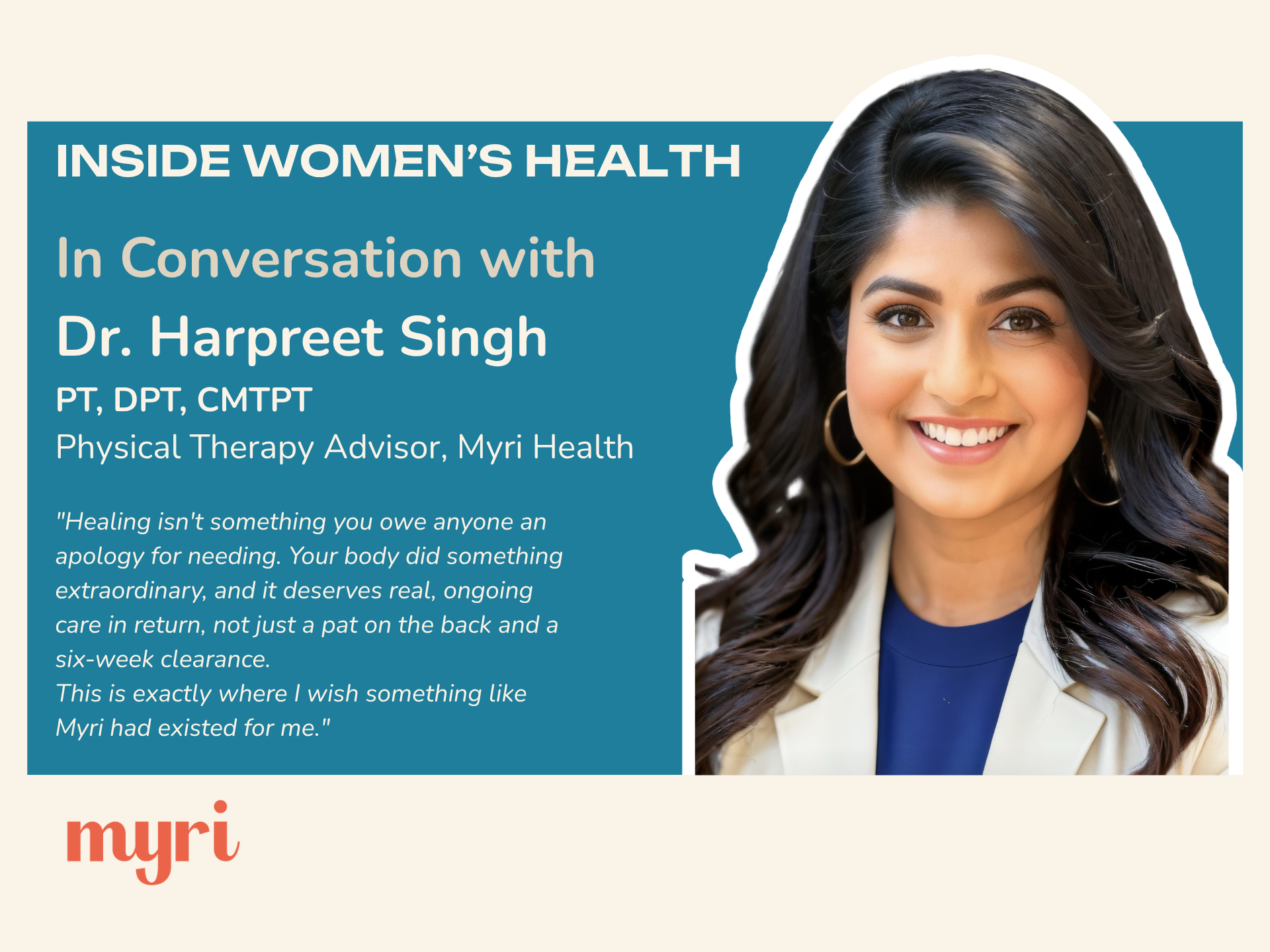
As healthcare professionals, clinicians often spend years understanding the human body, supporting patients, and recognizing symptoms early. But motherhood has a way of making even experts confront realities they didn’t fully expect personally.
In this conversation, we speak about navigating pregnancy and postpartum not just as a clinician, but as a mother herself. We are going to discuss Pelvic floor challenges, the normalization of postpartum discomfort, surprises in this journey of motherhood, what healthcare systems still miss, and why preventive maternal care needs to become the standard.
1. As someone with a deep understanding of women’s physiology and pelvic health, did pregnancy or postpartum still surprise you in ways you didn’t expect personally?
Honestly, yes. And that still humbles me. I had spent years treating patients, explaining perineal anatomy, coaching people through diastasis recti and prolapse. I thought I was as prepared as anyone could be. But knowing the anatomy on a whiteboard and treating a patient are completely different from actually living in a body that isn't healing the way the textbooks say it should.
What surprised me most wasn't just the pain itself (trust me, that was shocking in its own right); it was more so how isolating it felt. I kept waiting for my clinical knowledge to make the experience easier, and instead it sometimes made it lonelier, because I understood exactly what was going wrong and still couldn't fix it quickly for myself. Even advocating for myself as a healthcare practitioner, it felt at times like my voice fell on deaf ears. There's a real gap in our maternal care in this country, and the distance between knowing what "should" happen in a normal recovery and what happens when your body takes the harder road can feel even more defeating when you're fighting that fight on multiple fronts: at home, at work, and within your own head. At times, it's a daily struggle to keep trying and pushing forward.
2. Were there any physical symptoms or pelvic floor challenges you experienced yourself that made you realize how much mothers are expected to silently “push through”?
Multiple fissures, a surgery I didn't see coming, tailbone dysfunction that made sitting, just sitting, feel impossible for months. I was out of work for two years. Two years, as a pelvic floor specialist, unable to do the very job of helping other women heal, because my own body hadn't healed.
What struck me was how normal it felt to everyone around me, doctors and family members alike, for a mother to be in that much pain. People would deadpan or look fully alarmed when I started describing the nature of my postpartum pain. I remember taking 4–5 sitz baths for 20 minutes a day, for the first two years, contemplating how much I wanted to give up because the pain and debilitation were all too much. That's the moment it really landed for me; my experience alone would not be enough to carry me forward. We don't just push through pain; we're taught to hide that we're pushing through it, until we stop talking about it.
3.A lot of women normalize pain, leaking, pressure, or discomfort after childbirth. Why do you think so many mothers, even educated and informed women, delay seeking help for these issues?
A few reasons lay on top of each other. First, the cultural script, "leaking is just what happens after babies," "of course sex hurts, you just had a baby." These phrases get repeated so often they start to sound like medical fact instead of what they are: signs that something is not functioning well.
Second, the six-week check-up model fails us. One visit, a quick check, "everything looks fine," and you're discharged into the world with a newborn and a body you don't recognize. There's no ongoing relationship with a provider watching your recovery unfold over months, like you had previously during your pregnancy. So symptoms that would raise a flag in any other area of medicine get absorbed into "postpartum life."
And third, this is the one I feel most personally. Mothers are so depleted, physically and emotionally, that advocating for themselves takes a kind of energy they simply don't have, and even when they do speak up, they're often not heard. The village that existed even just one generation before us has become more difficult to find, and even more so to create. I had the clinical knowledge to know something was wrong, and it still took me a long time to learn how to prioritize my own care over everyone else's needs and create my village.
4. Did becoming a mother change the way you approach patients or think about postpartum recovery as a healthcare professional?
I feel I have always treated my patients and their diagnoses as part of a whole-person experience that includes grief, identity change, sleep deprivation, mental health, and a body that's telling a story the person may not have words for yet.
That said, I feel like I've developed a bit of a spidey sense now. When the pauses grow heavier, or her voice fades as she's speaking, I can sense that her inner voice is unsure whether it's safe to speak or ask a question. So I ask different questions now, not just "where does it hurt," but "what does a normal day look like for you," "who's helping you," "how are you sleeping," "how do you feel about your body right now." I give people permission to say things out loud that I wish someone had asked me. My own four-year recovery taught me that healing isn't linear, and that a good provider needs to be a steady presence through the non-linear parts, not just the milestones.
5. From your perspective, what are some of the biggest misconceptions women have about pelvic floor health during pregnancy and postpartum?
The biggest one is that pelvic floor issues are a "later in life" problem, or something that only happens after multiple births or a difficult delivery. I've treated everyone, from first-time mothers with significant dysfunction after seemingly straightforward births to women who have never had intercourse.
Second is the belief that leaking, pain with sex, or pelvic pressure are things you simply live with, that there's no real treatment, just management. In reality, pelvic floor physical therapy can meaningfully change these outcomes, often significantly, but too few women are ever told it exists as an option, let alone referred to it.
Third, and this one is close to home, is the idea that if you're "informed" or "prepared," you're somehow protected from a hard recovery. My own complications happened despite everything I knew. Preparation helps, but it isn't armor.
6. How closely do you think physical recovery and mental wellbeing are connected in motherhood, especially when mothers are struggling with unresolved pain or discomfort?
Inseparably connected. I don't think you can talk honestly about one without the other. Chronic pain changes how you move through your day, how you show up with your baby, how you feel about your own body, and eventually how you feel about yourself as a mother. My mental health challenges postpartum weren't separate from my physical ones, they were deeply tangled together. Pain that isn't taken seriously starts to feel like evidence that something is wrong with you, not just your body, and that's a heavy, quiet weight to carry.
I also think unresolved physical pain keeps the nervous system in a state of vigilance that makes it harder to feel calm, present, or bonded, not because a mother doesn't love her baby, but because her body is still in survival mode. Treating the physical piece is often part of what allows the mental and emotional healing to actually take hold. Top it off with unrealistic expectations like mothers "bouncing back," along with ongoing cultural and family pressures, and it can be extremely overwhelming.
7. At Myri, we believe preventive and continuous care can change maternal outcomes significantly. How can digital platforms help mothers identify concerns earlier and access support before issues become long term?
This is exactly where I wish something like Myri had existed for me. The biggest failure in the current system is the gap, long stretches of time between appointments where a mother is left to interpret her own symptoms with no guidance and no one checking in.
Having a digital platform that closes that gap by making it normal to report symptoms early and often (not just at the six-week visit) is invaluable. It can help mothers recognize that what they're experiencing isn't "just postpartum life" but something worth flagging, and connect them to the right specialist, a pelvic floor PT, a mental health provider, a lactation consultant, before a manageable issue becomes a years-long one. Continuous, low-friction check-ins also validate mothers in real time. Sometimes what changes an outcome isn't a new treatment, it's simply someone asking the right question at the right moment and taking the answer seriously.
8. If there’s one thing you wish every mother knew about her body after childbirth, what would you want her to hear?
That your pain is concrete, not a figment of your imagination. You are strong and resilient. You will get through this, but you need people in your corner.
If something feels wrong, it probably is wrong, and you don't need to wait for it to become unbearable, or wait for someone else to give you permission, before you ask for help. I spent years believing that pushing through quietly was part of being a good mother. It took surgery, two years away from a career I loved, and a four-year recovery to understand that healing isn't something you owe anyone an apology for needing. Your body did something extraordinary, and it deserves real, ongoing care in return, not just a pat on the back and a six-week clearance. You are allowed to take up space in your own recovery.
My dream is a world where women have in-home postpartum doula services to help offset care for themselves and baby, nutrition, activities of daily living, lactation, and general red-flag concerns. I would love for new mothers to have mandatory pelvic floor PT for 4–6 sessions postpartum to jumpstart recovery. I want them to have ongoing, safe, prescriptive exercise tailored to their bodies at appropriate times. I would love for them to be seen for mental health counseling and be integrated into new mother-baby networks for social support. Just a few of my ideas. We need our village back. I understand this isn't the reality for many of us, even when we have family close by. Myri takes a step closer to that reality, it holds space for safe exercise, red-flag reporting, and options for additional postpartum care.
%20(1).png)
.png)

.svg)


