.svg)

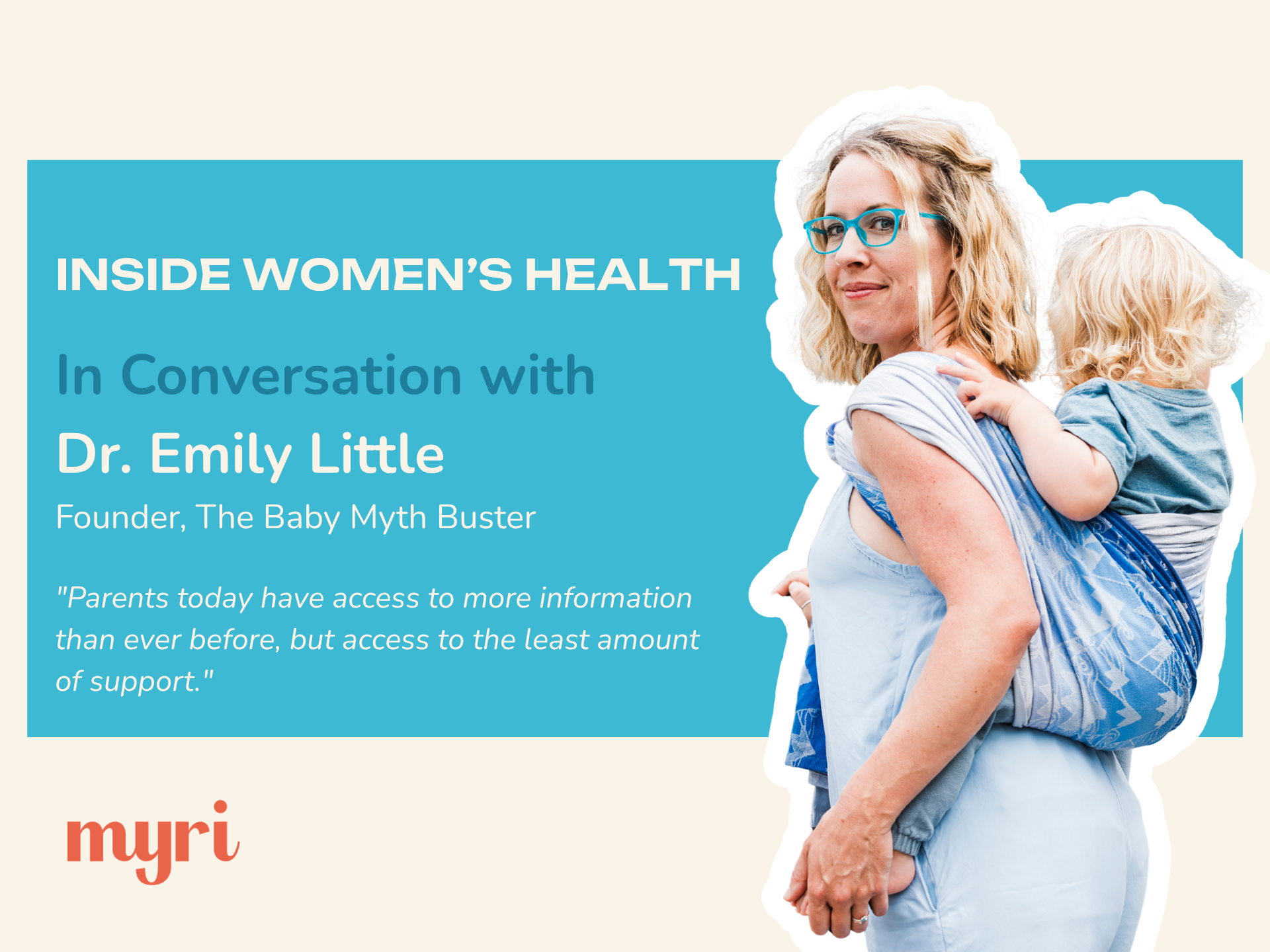
Today’s parents are surrounded by information, advice, opinions, and expectations: often all at once. But somewhere between social media, generational beliefs, and oversimplified parenting narratives, science can get lost.
Here we speak about translating maternal-infant research into real-world understanding, the myths shaping modern parenting culture, and how misinformation quietly impacts parental mental health, confidence, and wellbeing.
1. You created The Baby Myth Buster to bridge the gap between peer-reviewed research and public conversation. What made you feel that this gap needed urgent attention?
Bridging the gap between science and solutions has been my mission since starting my PhD program way back in 2012 at University of California, San Diego. It was a privilege to be in rooms with the world’s top scientists who were conducting research on infant development, human milk, and global health. Yet none of the information being shared in seminars and academic conferences was making its way out to the community. I went on to earn my PhD in developmental psychology and human origins, conducting research on parent-infant interactions around the world, and I was never satisfied by the major silos keeping scientific knowledge under wraps. Importantly, these silos also prevented information from flowing the other direction (from community to academia), so it was not just a problem of the science not being shared with the community, it was also a problem of scientists not always asking the right questions or being informed by lived experience and cultural knowledge.
I spent the past decade building a community-based organization to address this issue with local in-person programs for parents and perinatal health professionals. After scaling that organization from a group of volunteers to a seven figure high-impact institution, I shifted my focus to serving more organizations with a laser focus on my goal of translating research into real-world solutions. I just launched Nova “science for brighter beginnings” – a boutique science translation consulting studio where I work with companies, health systems, and public agencies to create science-backed solutions for infants and caregivers. The Baby Myth Buster is my passion project to ensure that I’m fulfilling my mission of reaching as many families as possible with culturally-informed research and preventative education.
2. A lot of parenting advice online is presented as universal truth, even when science says otherwise. What are some of the most common misconceptions about infant behavior or development that you find yourself constantly challenging?
The biggest misconception is that babies are supposed to be independent.
Much of modern parenting advice assumes that the developmental goal of infancy is to help babies separate from caregivers as quickly as possible. But from a biological and evolutionary perspective, human infants evolved to be highly dependent. They wake frequently, feed often, seek physical contact, and rely on caregivers to regulate their emotions and physiology.
Another misconception is that there is one "correct" way to raise a baby.
The more I've studied parenting around the world, the more obvious it has become that there are many pathways to healthy development. Babies thrive in a wide variety of cultural contexts. What matters most is not whether a baby sleeps in a particular location or follows a specific schedule. What matters is responsive caregiving and supportive relationships.
I also spend a lot of time challenging the idea that more products automatically lead to better outcomes. The baby industry is incredibly effective at convincing parents that babies are a problem that needs fixing, and the solution just happens to be in the form of a product.
3. You’ve spoken about translating research into narratives people can actually understand and apply. Why do you think evidence-based maternal and infant health information is still so inaccessible for many parents?
Part of the problem is that science was never designed for exhausted parents reading on their phones at 2 a.m.
Researchers are trained to write for other researchers. Scientific papers are dense, technical, and often hidden behind paywalls. Even when important findings emerge, it can take years, sometimes decades, before they influence public understanding.
Misinformation spreads extremely efficiently because it is emotionally compelling. And most often, highly relatable. A nuanced discussion of infant sleep biology cannot compete with an very relatable exhausted parent sharing their sleep-training success story.
I also think we underestimate how overwhelming the information environment has become. Parents today have access to more information than any generation in history, but more information does not automatically produce more confidence. In many cases, it creates more confusion.
That is why I focus so heavily on translation. The goal is to communicate research in a way that preserves nuance, respects parents, and helps them make sense of their own experiences.
4. In your work, how do unrealistic expectations around babies and parenting impact maternal mental health and parental wellbeing overall?
Unrealistic expectations are one of the most under appreciated drivers of parental distress.
Many parents are operating from a model of infancy that is fundamentally misaligned with biology. They expect babies to sleep independently, feed predictably, self-soothe quickly, and fit into adult schedules. When babies inevitably behave like babies, parents often conclude that they are failing.
That interpretation can be incredibly damaging.
I've met countless parents who felt anxious, inadequate, or overwhelmed not because their baby was doing anything objectively problematic, but because their expectations were based on societal ideals rather than developmental reality.
I see a similar pattern with mothers. Modern culture often tells women we should "bounce back" physically, professionally, and emotionally within weeks of giving birth. But the postpartum period is one of the most profound developmental transitions in adult life. Recovery, identity transformation, and adaptation take time.
The most powerful intervention is not another product or another strategy. It's helping parents prepare for what is actually normal.
When expectations become more aligned with biology, parents experience an immediate sense of relief. They stop asking, "What's wrong with my baby?" and start asking, "What is my baby communicating?"
That shift can transform not only parental confidence but family wellbeing as a whole.
5. There’s often pressure on parents to “optimize” every aspect of raising a child. From your perspective, how has modern parenting culture changed the emotional experience of motherhood and parenthood?
Parents today have access to more information than ever before, but access to the least amount of support. This creates a massive mismatch between burden of responsibility and what is actually achievable. Add the constant social media comparison of “perfect” parenthood and there’s a recipe for chronic emotional distress, feelings of failure, and burnout.
Part of tackling this emotional burnout requires busting the myth that parents need to “enrich” the lives of infants and children by making everything child-centered.
I love teaching baby carrying because it allows babies to have their needs met for closeness and responsiveness while also allowing parents to do what they need to do. This relieves so much of the pressure of parenting by giving parents permission to live their life as they want to and need to, and simply bring baby along.
6. You’ve worked across research, communications, and cultural analysis. Where do you think healthcare systems, media, or even wellness industries still misunderstand parents the most?
Many systems fundamentally misunderstand the difference between information and support.
When parents are struggling, our instinct is often to give them more information. Another article. Another app. Another educational program. Another product.
But parents are not suffering from an information deficit - they are suffering from a support deficit.
While working with families around the world, I observed that many cultures invest heavily in supporting caregivers rather than constantly instructing them. Postpartum traditions around the world often focus on rest, nourishment, practical help, and community care. By contrast, many Western systems place enormous responsibility on individual parents while offering relatively little structural support.
7. At Myri, we think a lot about proactive support instead of waiting until families are already overwhelmed. What role do you think science-backed education and early support play in improving outcomes for both parents and babies?
Prevention is one of the most underutilized tools in maternal and infant health.
The transition to parenthood is one of the most foundational periods in adult life, yet we often wait until families are already overwhelmed before offering meaningful support. We screen for postpartum depression and offer medication rather than encouraging universal prevention. We intervene when breastfeeding challenges become severe rather than equipping parents with the tools to face the challenges proactively. We respond when parents reach a crisis point.
But what if we prepared families earlier?
Science-backed education can help parents understand what is biologically normal before they encounter it. When parents know that newborns feed frequently, that sleep is highly variable, and that babies seek constant proximity, they are less likely to interpret those experiences as signs of failure. But the most effective prevention combines knowledge with practical support. Paid leave, mental health care, community programs, peer support, and accessible healthcare all help create the conditions under which families can thrive.
The future of maternal and infant health combines developmental science with systems that make caregiving easier rather than expecting parents to simply work harder.
8. If there’s one myth about babies, parenting, or maternal wellbeing you wish we could collectively let go of, what would it be, and what truth should replace it instead?
The myth I would most like us to let go of is the idea that babies can be "spoiled" by too much love, too much contact, or responding too quickly to their needs.
This belief is remarkably persistent, despite decades of developmental research suggesting the opposite. Human babies are born among the most dependent mammals on the planet. They arrive expecting close physical contact, frequent feeding, and responsive caregiving. From an evolutionary perspective, a baby who stopped signaling for a caregiver would have been far less likely to survive than one who signaled loudly and often, seeking contact.
Yet many parents still worry that holding their baby too much, responding too quickly, or comforting them when they cry will create dependency when in fact responsive caregiving helps build security. When babies learn that their needs will be met, they develop trust in both their caregivers and the world around them. This myth persists because our culture values independence very early in life. But development does not move from dependence to independence overnight. It moves from dependence to interdependence.
If we understood that infants need responsiveness and constant contact, then maybe we would build better systems to support the caregivers providing that constant love and contact. Maybe we would share the caregiving responsibilities more equitably. And maybe, we would build a society where people grow up confident and emotionally secure because their needs were met early on.
%20(1).png)
.png)
.svg)


